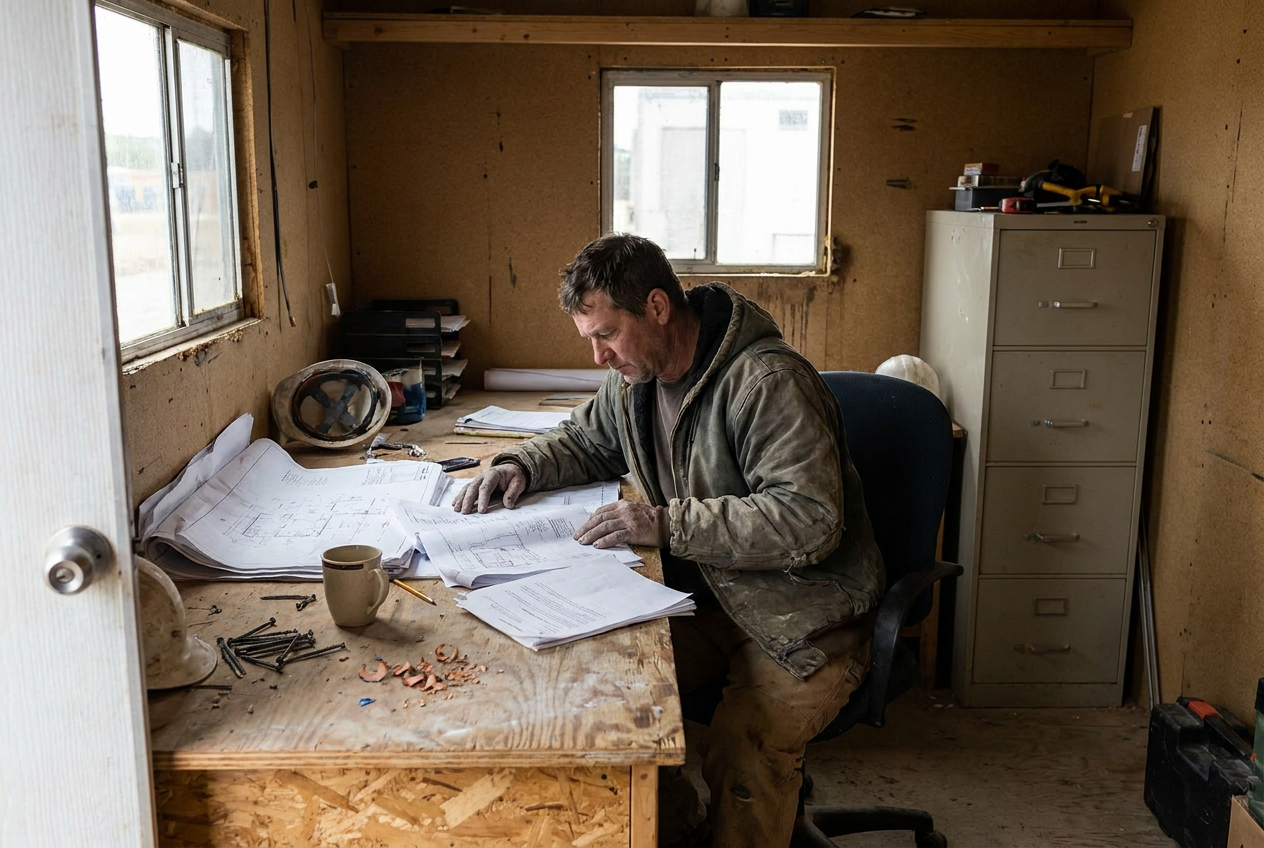
Most construction problems do not start in the office. They start on the job site, in the gap between what actually happened and what the office finds out about it later. A crew works through a schedule change that was never formally communicated. A subcontractor logs hours against the wrong job. A field supervisor resolves a scope issue on the fly and never documents it. By the time the office catches up, the project is already behind, and the cost has already moved.
Field operations management is the discipline of closing that gap. It covers how contractors plan, deploy, track, and report on field work, and how that activity connects back to the people, costs, and decisions happening in the office. When it works well, the field and office function as a single coordinated team. When it does not, the results are predictable: late projects, margin erosion, and the constant scramble to find out what is really happening on a job.
This guide covers the full scope of field operations and workforce management for contractors, including what it means, where it breaks down, what good practice looks like, and how technology, specifically Acumatica Construction Edition, helps teams execute more consistently at scale.
What Field Operations Management Really Means for Contractors
The term “field operations management” gets used loosely, but for contractors it has a specific meaning. It refers to everything involved in running work outside the office: coordinating crews, tracking time and labor, managing schedules, capturing documentation, communicating with the office, and ensuring that what is happening in the field is reflected accurately in the systems that run the business.
The Gap Between the Field and the Office
In most construction businesses, there is a structural delay between when something happens in the field and when the office knows about it. A supervisor closes out a phase of work on Thursday afternoon. The hours get written on paper and collected Friday morning. Payroll processes them the following week. By the time that labor hits the job cost report, the project manager is making decisions based on data that is already eight to ten days old.
This delay is not a symptom of poor management. It is a structural feature of disconnected systems. When field data and office systems do not communicate in real time, every decision made in the office carries some degree of lag. That lag is manageable when projects are small and margins are wide. It becomes a serious problem as projects scale, schedules compress, and margins tighten.
Modernizing field operations with real-time tools is the first step toward closing this gap. Contractors who have made this shift describe it as a fundamental change in how their teams operate, not just a technology upgrade. If you want a concrete example of what that shift looks like day-to-day, start here: modernizing field operations with Acumatica real-time tools for contractors.
Why Workforce Visibility Is a Financial Issue, Not Just an Operational One
Contractors sometimes treat workforce visibility as an HR concern. Where are my crews? Are they showing up on time? Is everyone on the right site? These are legitimate questions, but they understate the financial stakes.
Workforce visibility is a job costing issue. When you do not know in real time how many hours are being spent on a task, which crew is handling which phase, or how labor deployment compares to the original estimate, you lose the ability to catch cost overruns before they become unrecoverable. By the time a project is over budget on labor, the work is already done. The only variable left is how much damage you absorb.
Real-time workforce visibility changes the equation. When supervisors and project managers can see labor deployment against estimates while work is in progress, they can make adjustments: shift crews, revise schedules, resequence tasks. That ability to act on current information is what separates proactive field management from reactive cleanup.
The Real Cost of Disconnected Field Operations
Disconnected field operations have a hard cost and a soft cost. The hard cost shows up in rework, billing delays, late payroll corrections, and margin variances that get reconciled at month-end instead of addressed in the field. The soft cost is harder to quantify: decisions made with outdated information, opportunities missed because no one had current data, and the management overhead required to hold everything together manually.
Research on field productivity in construction consistently points to the same root causes of inefficiency: poor communication between field and office, lack of real-time data, and the administrative burden of manual processes. When these factors are addressed systematically, the gains show up across multiple dimensions at once. For a deeper dive into the “why” behind those breakdowns, see: why field productivity falls apart and how to fix it with Acumatica.

The Core Pillars of Effective Field Operations Management
Field operations management is not a single process. It is a set of connected disciplines that each have to work for the overall system to function. Understanding these pillars separately helps contractors identify where their operations are weakest and where to focus first.
Real-Time Jobsite Reporting
Jobsite reporting is how the field communicates with the office. In its most basic form, it is a daily log that captures what was completed, how many hours were spent, what materials were used, and whether anything notable happened (weather delays, equipment issues, subcontractor arrivals or absences).
The problem with traditional reporting is not that contractors do not do it. Most do. The problem is that it happens on paper, in emails, or in spreadsheets, and it arrives in the office hours or days after the work it describes. By the time the report is processed, the information is already historical rather than actionable.
Real-time jobsite reporting means field staff submit updates from a mobile device as work progresses. Those updates flow directly into the project record. The office sees them immediately. Project managers can flag issues, update schedules, and adjust plans based on what is actually happening rather than what they expect was happening based on a report from yesterday.
Mobile Time Tracking and Labor Data
Time tracking is one of the most operationally significant and most frequently broken processes in field operations. When time is captured accurately, coded correctly, and submitted promptly, it feeds reliable data into payroll, job costing, and scheduling. When it is not, the downstream effects ripple across every system that depends on labor data.
The most common failure mode is not dishonesty. It is friction. Paper timesheets require a collection step. Spreadsheets require a transfer step. Each step introduces delay and error. Field staff who work ten-hour days in demanding physical environments are not always well positioned to track time meticulously at the end of a shift.
Mobile time tracking removes the friction by making entry fast and simple on a phone or tablet, right on the job site. When the process is easier to do correctly than to shortcut, compliance improves and the data quality follows. We break the workflow down step-by-step in the companion article on mobile time tracking for construction and stopping payroll disputes.
Field-to-Office Data Flow Without Double Entry
Double entry is a silent tax on construction operations. When the same information has to be entered into a field log, a project management tool, and an accounting system separately, the cost is not just the time it takes. It is the errors introduced at every re-entry point, and the version control problem that results when three different systems each have a slightly different version of the same job data.
Eliminating double entry requires a connected system where field entry is the only entry. When a field crew logs hours from a mobile device, those hours should post directly to payroll and job costing without any additional manual step. When a supervisor submits a daily report, it should attach to the job record automatically. When a change order is approved in the field, it should update the budget and billing queue in the office immediately.
This kind of seamless field-to-office data flow is not possible with a stack of disconnected tools. It requires a platform that treats field entry and back-office processing as part of the same workflow. The full picture of how field-to-office data gaps affect operations is covered in the companion article on eliminating rework, delays, and cost surprises with real-time ERP.
How Workforce Management Failures Lead to Job Cost Overruns
Job cost overruns are rarely a single event. They are the accumulation of small misses across many processes over the life of a project. Workforce management failures are a primary source of these small misses.
When Labor Data Arrives Too Late
Job costing requires timely labor data. When hours posted to a job are current, project managers can see cost-to-complete estimates that reflect reality. They can catch overruns early, when there is still time to adjust scope, resequence tasks, or have a conversation with the owner about a change in conditions.
When labor data arrives late, the job cost report becomes a history document rather than a management tool. Project managers are flying on instruments that are always pointing to last week. The variance they see in the report is not the variance they can fix. It is the variance they have already absorbed.
For contractors managing multiple active jobs simultaneously, this lag can be catastrophic. A labor overrun on one project can cross a threshold into an unrecoverable loss before anyone sees the numbers.
Change Orders That Never Make It Into the System
Change orders are a normal part of construction. Scope evolves. Conditions change. Owners make decisions in the field that have cost implications. The operational question is not whether change orders will happen. It is whether they will be captured, priced, approved, and posted before the work is done.
In many organizations, the answer is often no. A verbal approval on site leads to work being completed before a formal change order is processed. By the time the paperwork catches up, the contractor is either billing retroactively or absorbing costs that should have been recovered.
Every undocumented change order is a potential margin leak. At scale, across a portfolio of active projects, these leaks can represent significant lost revenue. A field operations management system that includes mobile change order submission and approval closes this gap before the work happens rather than after.

Schedule Gaps That Compound Across Projects
Schedule management is fundamentally a labor management problem. When crews are deployed against an accurate, current schedule, work flows efficiently. When the schedule is out of date, or when field conditions have diverged from the planned sequence, crews can end up waiting, working on the wrong phase, or duplicating effort.
Schedule gaps are hard to see without real-time visibility into where crews are and what they are doing. They are easy to see after the fact, when the job finishes late or over budget and the project timeline is reconstructed to understand why. By then, the cost is already sunk. The goal of field operations management is to surface schedule deviations while there is still time to respond.
What Effective Field Operations Management Looks Like in Practice
The theory is straightforward: connect field activity to office systems in real time, remove manual steps, and give everyone current information. The practice requires attention to how crews actually work and what makes adoption realistic rather than aspirational.
Real-Time Scheduling and Crew Deployment
An effective field operations system gives dispatchers and project managers a current view of crew locations, active assignments, and schedule adherence. When a crew finishes a phase ahead of schedule, the system should make it easy to reassign them immediately rather than leaving them idle while someone figures out what to do next.
This requires scheduling tools that are connected to the field in real time. It also requires that the schedule in the system reflects what is actually happening, not a plan that was last updated a week ago. Real-time scheduling is not about automating decisions; it is about giving the people making decisions the information they need to make good ones fast.
Simplified Field Reporting That Does Not Slow Down Crews
One of the most common reasons field reporting breaks down is that the reporting process is too burdensome for field crews to complete consistently. If filling out a daily log takes fifteen minutes and the form is complicated, it will not get filled out reliably. If it takes two minutes and asks clear, specific questions, compliance improves significantly.
Effective field reporting is designed around the person doing the reporting, not around the person receiving it. The interface should be fast on a mobile device. The fields should be limited to what is genuinely necessary. The submission should take one tap.
If you are trying to make daily logs easier for crews to complete consistently, this practical guide is a good next read: simplifying field reporting without slowing down your crew.
Field Documentation Connected to the Job Record
Field documentation, including photos, inspection notes, material delivery receipts, and safety incident reports, has significant operational and legal value. It is also frequently disconnected from the job record, living in a camera roll, an email thread, or a shared folder that no one has organized.
When field documentation is captured through a mobile ERP app and attached directly to the job record, it becomes useful in real time. Project managers can see site conditions without being on site. Inspectors can pull up photos of completed work without tracking down the supervisor who took them. Billing teams can attach documentation to invoices without hunting through email.
This connection between what happens in the field and what lives in the system is one of the highest-value improvements available to contractors who are still managing documentation outside their ERP.

How Acumatica Supports Construction Field Operations
Acumatica Construction Edition is built for the way construction companies actually work. It is not a generic ERP with a construction module bolted on. The platform is designed around projects, jobs, and the people who run them, with mobile capabilities that make field adoption realistic rather than forced.
Mobile ERP Designed for the Job Site
Acumatica’s mobile interface supports the full range of field operations tasks: time entry, daily reporting, change order submission, photo documentation, expense capture, and crew communication. These workflows are designed to work on a phone or tablet in field conditions, which means fast load times, offline capability, and simple navigation.
When field teams have a tool that works where they work, adoption follows. Contractors who implement Acumatica consistently report that mobile adoption is higher than they expected because the interface is designed for speed, not for office users who happen to be in the field.
If your business includes ongoing service work, this article shows how connected ERP workflows improve dispatch, labor tracking, and profitability: how field service contractors use ERP to boost efficiency and profit.
Connected Workflows Across Every Job Function
The most significant advantage of Acumatica for field operations is not any single feature. It is the fact that all job functions, field labor, project management, job costing, billing, payroll, and procurement, operate in the same system with shared data.
When hours are submitted from the field, they post to payroll and job costing simultaneously. When materials are received on site, inventory and job costs update without a separate data entry step. When a change order is approved, the budget and billing queue reflect it immediately. There is no reconciliation step because there is no data transfer between systems.
This connected architecture is what makes real-time visibility possible. It is not a reporting feature. It is a structural property of how the system is built.
Implementation That Fits How Your Teams Work
Acumatica is a flexible platform, but flexibility alone does not produce good outcomes. The difference between a successful implementation and a failed one is almost always in the configuration and the process design that precede it.
The questions that matter most before go-live are not about features. They are about process: How does your organization track labor today? Where does approval authority sit? How are change orders currently submitted and approved? What does a well-run project look like in your business, and what does a struggling one look like?
When implementation is approached as a process design exercise first and a software installation second, the result is a system that fits how the organization actually works rather than one that forces the organization to adapt to the software.
Where to Start When Your Field Operations Need to Improve
Knowing that field operations need to improve is not the same as knowing where to start. Most contractors who engage with this problem have multiple pain points, and the temptation is to address all of them at once. That approach rarely produces the intended result.
Identify Your Biggest Bottleneck First
The most effective place to start is with the pain point that has the highest operational cost and the clearest connection to a solvable process. For many contractors, that is late or inaccurate labor data. For others, it is undocumented change orders. For others still, it is the inability to get current job cost data without waiting for a weekly report.
Pick one problem, solve it completely, and build from there. A focused improvement that is fully adopted delivers more value than a comprehensive overhaul that is never fully embraced by the teams who have to use it. The contractors who see the fastest results from technology investments are almost always the ones who started with a specific operational problem and a clear definition of what success looks like.
Build the Process Before the Software
One of the most common implementation mistakes is treating software as a substitute for process design. If the approval workflow for time is unclear before implementation, the software will not clarify it. If job and cost code standards are inconsistent, the ERP will not fix them. Software enforces the process you give it. If the process is unclear, the software will enforce the confusion at scale.
Before any technology rollout, document the current state of your field operations processes. Where does information originate? Who approves it? Where does it go next? Where does it get lost? That map becomes the foundation for both the process redesign and the system configuration.
Process standardization and strong fundamentals are what make field operations improvements stick, and technology delivers the best return when it is built on clear workflows, consistent job and cost code standards, and reliable accountability.
How DC Tech Group Helps Contractors Make the Transition
DC Tech Group specializes in implementing Acumatica Cloud ERP for commercial contractors, homebuilders, residential contractors, and field service providers across the United States. The team brings decades of hands-on experience with construction operations and configures the platform to match how specific organizations work, not how a generic implementation guide assumes they work.
The implementation process starts with process review, moves through configuration and testing, and includes comprehensive training for both field and office teams. Ongoing support means clients do not have to figure out evolving needs on their own after go-live.
If your field operations are costing you more than they should, whether through late data, undocumented changes, payroll friction, or a lack of real-time visibility, the path forward starts with a conversation. Contact DC Tech Group to discuss what a connected field operations system could look like for your organization.